TCF POST Special Report
For two days in late October, the Palais de Chaillot in Paris was turned into a darkened chamber of gold and silver. “Lineage of Gold * Lineage of Silver,” staged on 22 and 23 October by the Cabinet Office of the Government of Japan, brought around 60 works of traditional Japanese craft before more than 300 guests from Europe’s luxury, business, political and creative circles, along with established collectors.
The show was the latest outing for the Sui Collection, a government initiative to present outstanding Japanese artistry from across the country. Its curator, author and cultural producer Mari Hashimoto, built the exhibition around two metals with very different personalities: gold and silver. The objects came from gallery representation, institutional collections and the archives of traditional craft workshops, and they covered lacquerware, metalwork, ceramics, sword-making and textiles.
The light, and the leaf
The gallery itself was part of the argument. Lighting designers Akari-Lisa Ishii and Motoko Ishii reworked the space as an installation called La Cathédrale, picking out each object through shadow and atmosphere. Under that light, visitors met techniques that rarely travel. One was kirikane, in which gold and silver leaf is applied to Buddhist statues and paintings. Another was kinkarakami, a gilded embossed technique.
The organisers said guests were drawn above all to the textiles, ceramics and gold leaf works, and to pieces made with especially demanding methods.
Cords that took the room
Among the most complex was a set of Kumihimo-Nara-gumi cords by Dōmyō. Cord-making sounds modest, but the release lists a vocabulary of twisting, braiding, weaving and concealed stitching. Here the cord is the work itself rather than a trim or an afterthought.
The obi as vessel
The other textile standout was the embroidered obi by Kondaya Genbei. The obi is rooted in ancient traditions of binding the body and in the Shinto concept of yorishiro, an object that can hold a divine presence. For a European audience used to thinking of the belt as an accessory, that is a different idea of what a textile is for. According to the organisers, Kondaya Genbei keeps this legacy alive through innovative materials and artistry, and the piece proved one of the most popular on view.
Old craft, new language
The curation also made room for the present. Terumasa Ikeda’s “Remnant: Stone” pairs shimmering shell inlay with laser-cut numbers and lines on ultra-thin lacquer. It joins traditional raden craftsmanship to digital-inspired motifs, and it suggests that heritage here means a living method that can take on new tools.
A philosophy of ownership
The government’s own framing came in a speech by Masaya Kitao, Councillor at the Cabinet Secretariat. He described the Sui Collection as a journey to discover the beauty “hidden across Japan,” and said the crafts on show were only a small part of a rich inheritance. His central idea was that a craft’s story truly begins when it is placed in the hands of someone who understands it, and that each owner adds a new chapter. He also spoke of a responsibility to preserve these traditions and let them resonate with other cultures without losing their essence.
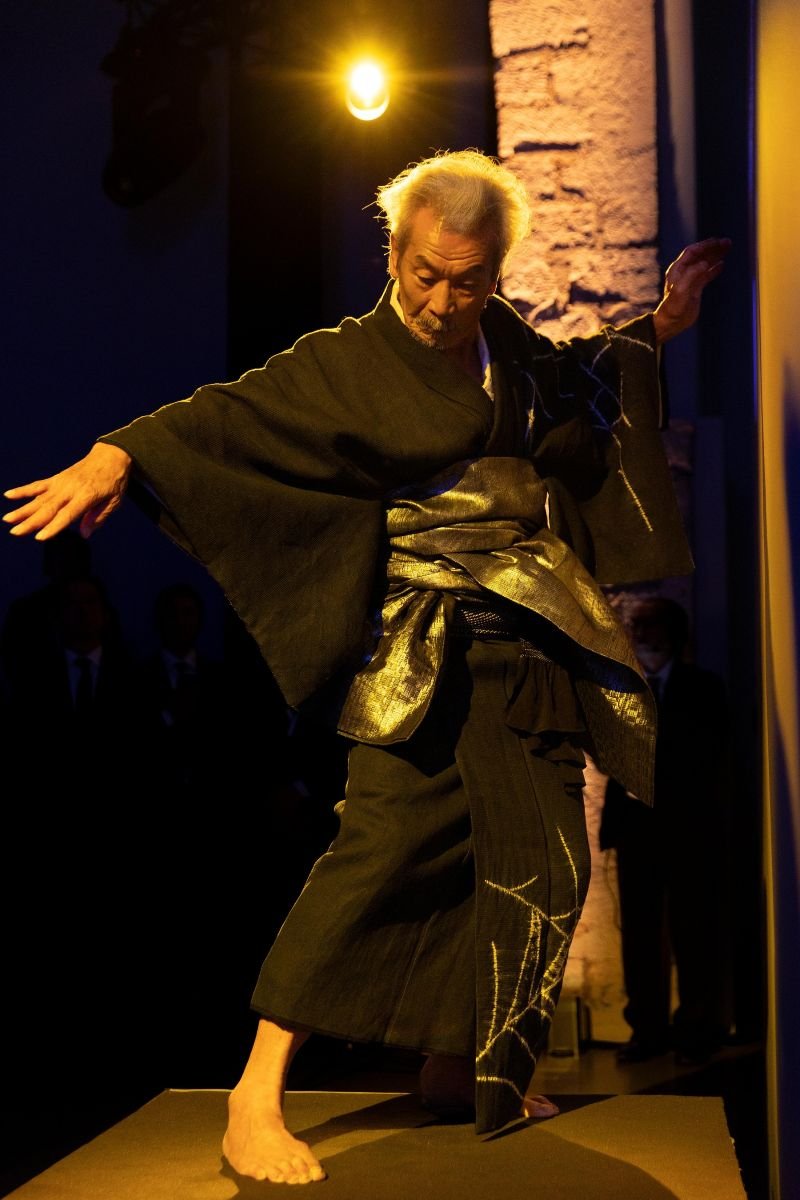
The evening was rounded out by dishes from L’Abysse Paris, overseen by chef Yannick Alléno and sushi chef Yasunari Okazaki, and by a performance from dancer Min Tanaka, known for improvisation-led work on the body and movement.
What it signals
The exhibition was not a sales floor, and it invites a reading rather than a purchase. Still, the message to the luxury world is clear. In an era when provenance and making increasingly shape what buyers value, Japan is presenting its textile and craft lineages as a living, transferable inheritance, and it is doing so to the people who commission, collect and curate.